If you’re deciding between a PlayStation 5 and an Xbox Series X|S, or you just need a spare pad for couch co-op, the stock controllers that ship with each console are more different than they look. Both are comfortable, well-built, and reliable — but they take genuinely different approaches to feedback, battery life, and extra features. Here’s how the standard Sony DualSense Wireless Controller and the standard Xbox Wireless Controller actually compare, without getting into the premium Elite or Edge models.
Microphone and extra inputs
The DualSense also includes a built-in microphone array, letting you jump into party chat without a headset in a pinch — a small but genuinely convenient feature the Xbox pad doesn’t attempt to replicate. Neither pad includes a headphone jack by default in every region/version, so check the specific listing if wired audio output from the controller itself matters to you.
Haptics and adaptive triggers
The DualSense’s biggest differentiator is still its haptic feedback and adaptive triggers. In supported games, you can feel the crunch of gravel underfoot or the resistance of drawing a bowstring through the triggers themselves — something the Xbox Wireless Controller simply doesn’t attempt. If immersion in single-player PS5 exclusives is the priority, this is a real, tangible advantage, not just marketing.
Battery life and charging
This is where Xbox pulls ahead. The Xbox Wireless Controller runs on AA batteries or a rechargeable battery pack and routinely lasts 30+ hours per charge. The DualSense’s built-in battery, partly because it powers the haptics and speaker, typically needs a recharge every 8-12 hours of play. If you hate charging controllers, that gap matters more than most spec sheets suggest.
Build, grip, and extras
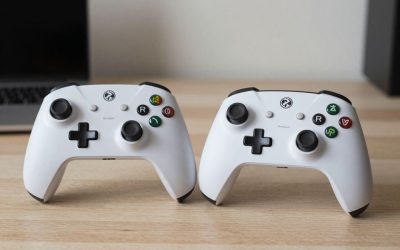
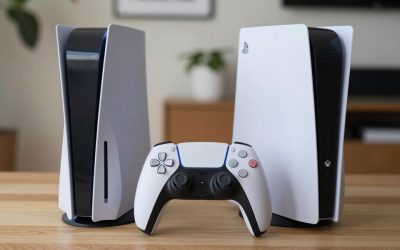
The DualSense has a more rounded, slightly larger shell with a built-in microphone and a touchpad that doubles as a trackpad-style input — useful in menus and a handful of games that support swipe gestures. The Xbox pad keeps the familiar Xbox One shape with textured grips and a slightly more compact feel that many hands find easier for long sessions. Both support Bluetooth for PC and mobile use, and both work well as a secondary controller regardless of which console you own.
Price and value
Street pricing for both standard controllers lands in a similar range, so this isn’t really a budget decision — it’s a feature-priority one. Buy the DualSense if adaptive triggers and haptics matter to you or you’re buying exclusively for PS5. Buy the Xbox Wireless Controller if battery life and a familiar, no-frills shape matter more, or if you split time between Xbox and PC.
Premium versions: DualSense Edge vs Elite Series 2
Both platforms also offer a premium step-up — the DualSense Edge and Xbox Elite Series 2 — with swappable thumbstick modules, remappable paddles, and adjustable trigger stops. These are worth considering if you play competitively enough to want that level of customization, though they triple the price of the standard pads covered above and aren’t necessary for casual or couch co-op use.
Frequently Asked Questions
Does the DualSense work on PC?
Yes, via USB-C or Bluetooth, though haptic feedback and adaptive triggers only work in the small number of PC titles that specifically support them.
Can I use an Xbox controller on PS5?
No — Xbox controllers are not natively supported on PS5, and vice versa. Cross-platform use is effectively limited to PC.
Is the touchpad on DualSense actually useful?
It’s mostly used for menu navigation and a handful of specific mechanics (like map-swiping in some titles). It’s a nice-to-have rather than something that should drive the purchase.
Which controller is better for fighting games?
Neither has a clear edge for fighting games specifically — most competitive fighting game players who care deeply about input precision end up on a fight stick rather than either standard pad, making this largely a non-factor in the PS5-vs-Xbox controller decision.
Do both controllers support gyroscopic motion controls?
The DualSense includes motion sensing used in a handful of PS5 titles for aiming or puzzle mechanics; the standard Xbox Wireless Controller does not include equivalent motion sensing, which is a minor but real feature gap if a specific game you play relies on it.
Which controller is more durable long-term?
Both hold up well under normal use, though the Xbox pad’s simpler internals (no haptics, no built-in rechargeable battery by default) mean there are fewer components that can eventually fail compared to the DualSense’s more complex feature set.
Can I buy spare parts for either controller if something breaks?
Both Sony and Microsoft sell some official replacement parts, and third-party repair kits exist for common failure points like analog stick modules and shells, though neither standard controller is as repair-friendly as the premium Edge or Elite Series 2 with their tool-free swappable components.
Which controller is better for younger or smaller hands?
The Xbox pad’s more compact, traditional shape tends to fit smaller hands a bit more comfortably than the DualSense’s larger, rounder shell, though both remain usable across a wide range of hand sizes for most players.
Do colorway options differ much between the two?
Both Sony and Microsoft release frequent limited-edition colorways beyond basic black and white, so neither platform has a meaningful advantage in choice — it comes down to whichever specific color drops you prefer at the time you’re buying.
Final Thoughts
Neither controller is objectively “better” — they’re built around different priorities. If you want to feel more connected to PS5-exclusive games, the DualSense delivers something Xbox doesn’t offer. If you’d rather not think about charging and prefer a slightly more compact grip, the Xbox Wireless Controller is the lower-maintenance choice.


Write Your Review
No reviews yet. Be the first to share your experience!